
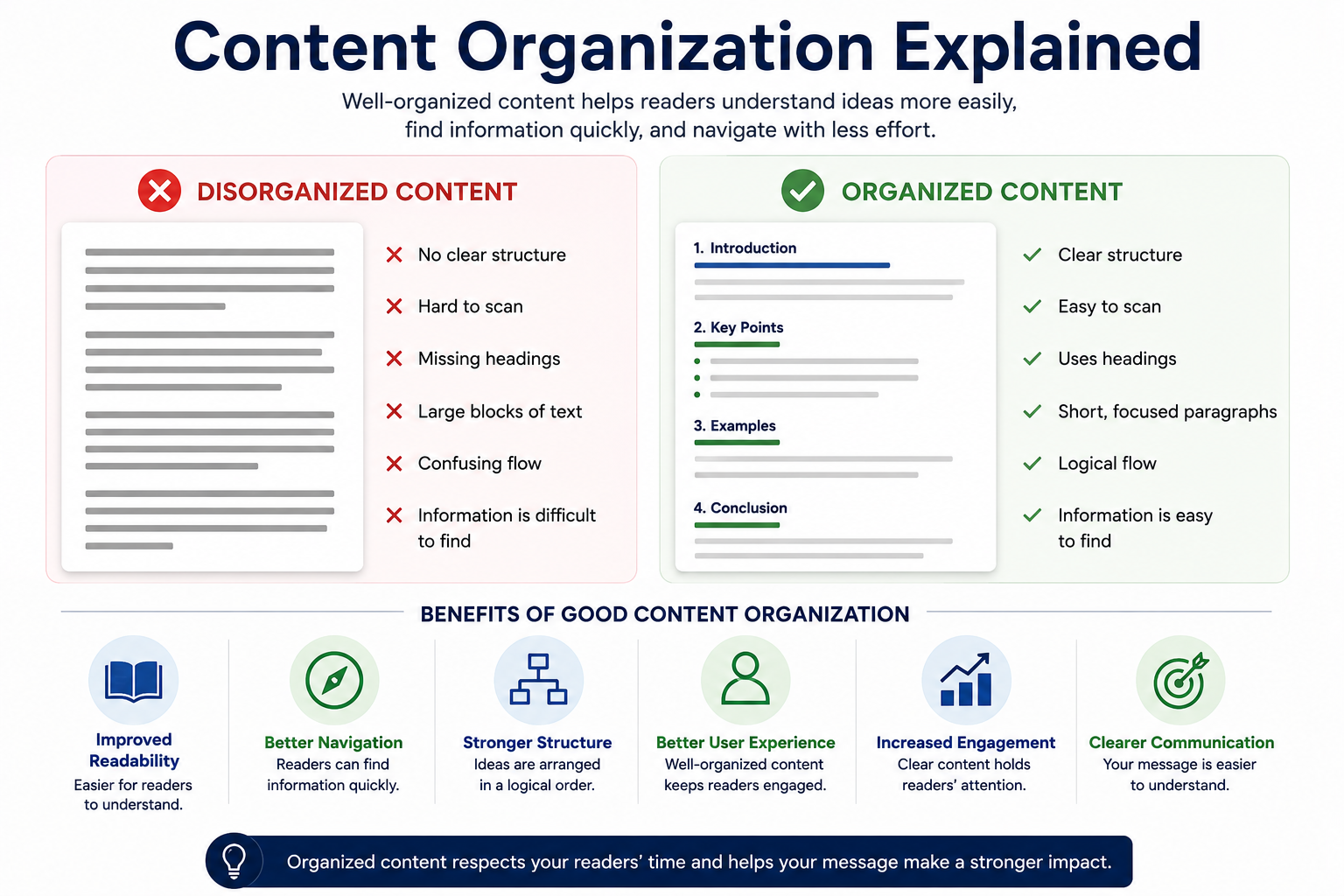
Content organization refers to the process of arranging information in a logical and structured way. Well-organized content helps readers understand ideas more easily, locate important information quickly, and navigate through material with less effort.
Whether you’re creating articles, reports, emails, blog posts, website pages, or business documents, effective organization can improve clarity, readability, and overall communication.
Why Is Content Organization Important?
Readers often scan information before reading it in detail. A clear structure helps readers understand how ideas relate to one another and where to find relevant information.
Benefits of effective organization include:
- Improved readability
- Better user experience
- Easier navigation
- Stronger communication
- Increased engagement
- Clearer presentation of ideas
As a result, readers can process information more efficiently and remain focused on the content.
Common Elements of Organized Content
Several elements contribute to strong content organization.
| Element | Purpose |
|---|---|
| Headings | Organize major topics |
| Subheadings | Divide content into sections |
| Paragraphs | Group related ideas |
| Lists | Improve scannability |
| Formatting | Improve visual structure |
| Transitions | Connect ideas logically |
Together, these elements help create content that is easier to understand and navigate.
Signs of Poor Organization
Disorganized content can make information difficult to follow.
Common signs include:
- Missing headings
- Large blocks of text
- Abrupt topic changes
- Repeated information
- Inconsistent formatting
- Unclear structure
Fortunately, many of these issues can be corrected by reorganizing information and improving structure.
How Better Organization Improves Readability
Readers often find structured content easier to scan and understand.
For example, organized content can help readers:
- Find information quickly
- Understand relationships between ideas
- Navigate longer documents
- Follow information logically
Learn more in our guide: Readability: What It Is and Why It Matters.
Content Organization and Structure
Organization and structure often work together.
Structure provides the framework for presenting information, while organization determines how ideas are arranged within that framework.
Learn more in our guide: Writing Structure: What It Is and Why It Matters.
Common Mistakes
Mixing Unrelated Topics
Combining unrelated ideas within the same section can confuse readers.
Skipping Section Labels
Missing headings and subheadings can make content difficult to navigate.
Ignoring Paragraph Organization
Poorly organized paragraphs can interrupt the flow of information.
Learn more in our guide: Paragraph Structure: What It Is and Why It Matters.
Overlooking Formatting
Formatting helps readers distinguish between sections and understand content hierarchy.
Learn more in our guide: What Is Text Formatting?
Create More Organized Content
Whether you’re writing articles, reports, emails, website pages, or business documents, effective organization can improve readability and communication. Presenting information in a logical structure helps readers understand ideas more easily and navigate content more efficiently.
FAQs
Content organization is the process of arranging information in a logical way to improve clarity, readability, and navigation.
Good organization helps readers understand information more easily and improves the overall user experience.
Using headings, paragraphs, lists, and logical sequencing can help create more organized content.
Yes. Well-organized content is often easier to read, understand, and navigate.
Yes. Clear organization can improve readability, navigation, user experience, and overall content quality.